Detailed slide-by-slide text content extracted from this presentation.
Slide 01
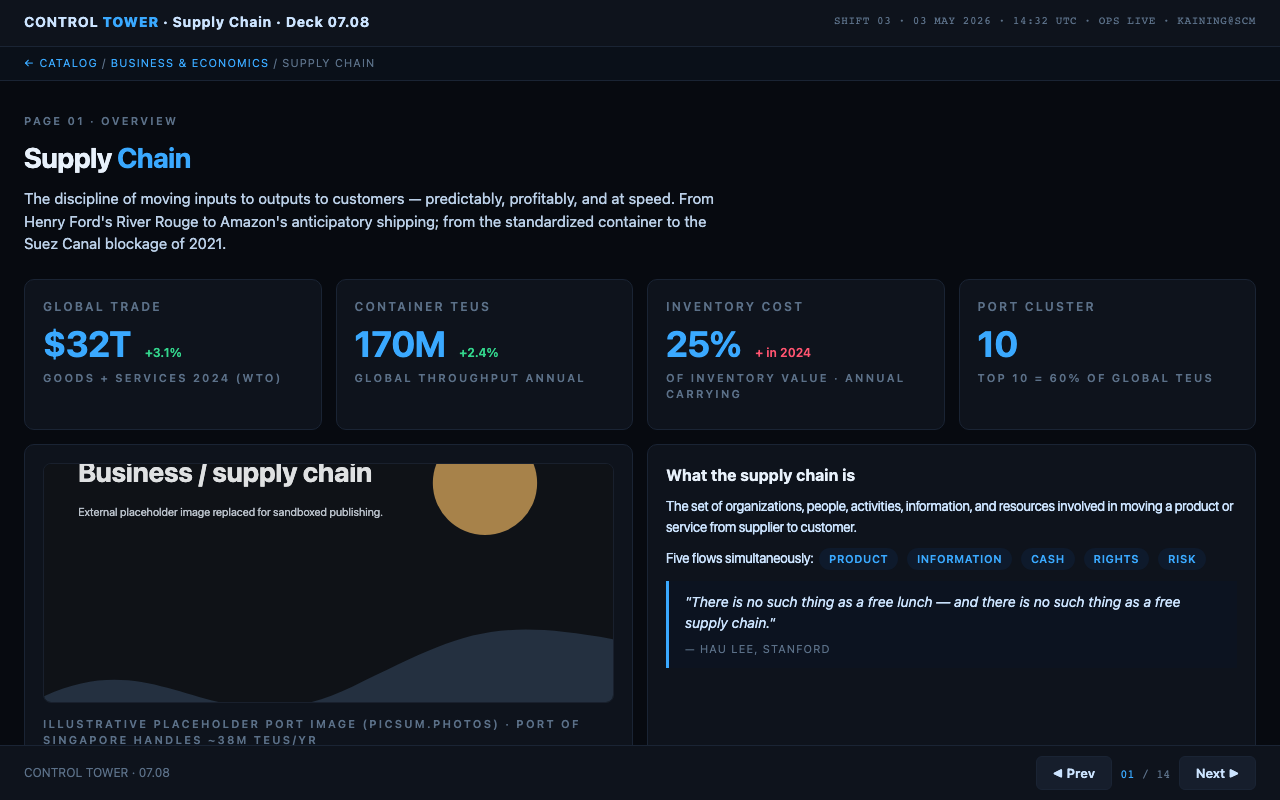
Supply Chain Management
- The Backbone of Global Commerce
- How goods flow from raw materials to consumers -- the strategies, technologies, and challenges of managing the world's most complex networks
- 1 / 32
Slide 02
What Is Supply Chain Management?
- Supply Chain Management (SCM) encompasses the planning, execution, and control of all activities involved in sourcing, procurement, conversion, and delivery of products -- from raw material extraction through to the end consumer and beyond (returns, recycling).
- A supply chain is not a chain at all but a complex, interconnected network of suppliers, manufacturers, distributors, retailers, and service providers collaborating to deliver value. Modern supply chains span dozens of countries, involve hundreds of organizations, and handle millions of SKUs.
- "Supply chain is like nature. It is all around us."
- -- Dave Waters
- $19T
- Global logistics market size
- 80%
- Of global trade by volume moves by sea
- 10.7B
- Tons of goods shipped by sea annually
- 2 / 32
Slide 03
Evolution of Supply Chain Thinking
- 1910s-1960s: Mass Production Era
- Henry Ford's vertical integration -- owning everything from rubber plantations to showrooms. Focus on efficiency through scale and standardization. Inventory was "good" because it enabled uninterrupted production.
- 1970s-1980s: Japanese Revolution
- Toyota Production System introduced Just-in-Time (JIT), kanban, and lean manufacturing. Shifted focus from "push" (produce then sell) to "pull" (produce what's demanded). Quality management (TQM, Six Sigma) became paramount.
- 1990s-2000s: Globalization and Outsourcing
- Companies disaggregated supply chains globally to chase lowest costs. Offshoring manufacturing to China and services to India. ERP systems (SAP, Oracle) enabled coordination. "Supply chain" entered business vocabulary.
- 2010s-Present: Digital and Resilient
- IoT sensors, AI-driven forecasting, blockchain traceability. COVID-19 exposed fragility of hyper-optimized global chains. Shift from "just-in-time" toward "just-in-case" and regionalization. ESG pressures add sustainability requirements.
- 3 / 32
Slide 04
Core Functions of SCM
- Plan
- Demand forecasting, supply planning, S&OP (Sales and Operations Planning), capacity planning. Balancing supply with demand while minimizing costs and maximizing service levels.
- Source
- Supplier selection and management, procurement, contract negotiation, quality assurance, and supplier relationship management. Strategic sourcing decisions shape entire supply chain architecture.
- Make
- Manufacturing, assembly, and production operations. Production scheduling, quality control, lean manufacturing, and capacity management. Decisions about make-vs-buy and production location.
- Deliver
- Warehousing, transportation, distribution, order management, and last-mile delivery. The physical movement of goods from production to consumption, including reverse logistics.
- Return
- Reverse logistics, product returns, recycling, and disposal. Growing in importance with e-commerce (30% return rate for online fashion) and circular economy mandates.
- Enable
- IT systems, risk management, compliance, sustainability tracking, and performance measurement. The infrastructure that makes everything else function.
- 4 / 32
Slide 05
Demand Forecasting
- Accurate demand forecasting is the foundation of effective supply chain management. Every other decision -- how much to produce, where to stock inventory, how many workers to hire -- depends on understanding future demand.
- Forecasting Methods
- Time series: ARIMA, exponential smoothing, moving averages
- Causal models: Regression incorporating external variables
- Machine learning: Neural networks, gradient boosting, deep learning
- Judgmental: Expert opinion, Delphi method, market research
- Hybrid: Combining statistical and human judgment
- The Bullwhip Effect
- Small fluctuations in consumer demand amplify dramatically as they propagate upstream through the supply chain. A 5% increase in retail sales might cause a 40% spike in factory orders. Causes: order batching, price fluctuations, rationing, and demand signal processing. Solutions: information sharing, collaborative forecasting (CPFR), and reducing lead times.
- AI-powered demand sensing uses real-time signals (weather, social media, events, POS data) to improve short-term forecast accuracy by 20-50% compared to traditional statistical methods.
- 5 / 32
Slide 06
Inventory Management
- Inventory is simultaneously a company's most valuable asset and its greatest liability. Too much ties up capital and risks obsolescence; too little causes stockouts and lost sales.
- Inventory Types
- Raw materials: Inputs awaiting production
- Work-in-progress (WIP): Items in production
- Finished goods: Ready for sale
- Safety stock: Buffer against variability
- Cycle stock: Normal replenishment quantities
- Pipeline/transit: Goods in transportation
- Key Models and Metrics
- EOQ: Economic Order Quantity (balances ordering and holding costs)
- ABC analysis: Classify items by value (80/20 rule)
- Inventory turns: How often stock cycles (higher = better)
- Days of supply: How long current stock lasts
- Fill rate: Percentage of demand met from stock
- GMROI: Gross Margin Return on Inventory Investment
- Amazon's inventory strategy exemplifies modern thinking: using predictive algorithms to pre-position products near likely buyers before orders are placed, reducing delivery time while maintaining lean overall inventory levels.
- 6 / 32
Slide 07
Procurement and Sourcing
- Strategic procurement has evolved from a cost-center focused on negotiating lowest prices to a value-creating function that shapes competitive advantage through supplier relationships, innovation, and risk management.
- Strategic Sourcing Decisions
- Single source vs. multi-source strategies
- Domestic vs. global sourcing trade-offs
- Make vs. buy analysis
- Total cost of ownership (beyond unit price)
- Supplier development and capability building
- Category management approach
- Supplier Relationship Management
- Transactional: Commodity purchases, price-focused
- Collaborative: Joint planning, shared information
- Strategic partnership: Co-development, shared risk/reward
- Keiretsu: Deep integration (Japanese model)
- Toyota maintains relationships with suppliers spanning decades, investing in their capabilities while demanding continuous improvement.
- 7 / 32
Slide 08
Logistics and Transportation
- Moving physical goods efficiently across distances is logistics' core challenge. Transportation typically represents 50-70% of total logistics costs.
- Ocean Freight
- Carries 80% of world trade by volume. Container ships carry 24,000+ TEU. Transit times: 2-6 weeks. Cheapest per unit but slowest. Key routes: Asia-Europe, Trans-Pacific, Trans-Atlantic.
- Air Freight
- Only 1% of trade by volume but 35% by value. Transit: 1-3 days. Expensive but essential for high-value, time-sensitive, or perishable goods. FedEx, UPS, DHL dominate express.
- Road Transport
- Most flexible mode for domestic distribution. Full truckload (FTL) vs. less-than-truckload (LTL). Last-mile delivery is the most expensive and complex segment. Driver shortages are a chronic challenge.
- Rail
- Efficient for heavy, bulk goods over long distances. Intermodal containers enable sea-rail connections. China-Europe rail (Belt and Road) offers middle ground between sea and air.
- Pipeline
- Specialized for liquids and gases (oil, natural gas, water). Highest fixed cost but lowest variable cost per unit. Geopolitically significant (Nord Stream, Trans-Siberian).
- Last Mile
- Final delivery to consumer. Most expensive segment (53% of total shipping cost). Innovations: drones, autonomous vehicles, micro-fulfillment centers, crowdsourced delivery.
- 8 / 32
Slide 09
Warehousing and Distribution
- Modern warehouses are highly automated technology centers rather than simple storage facilities. They serve as critical nodes in fulfillment networks, enabling speed and efficiency.
- Warehouse Operations
- Receiving: Inbound goods processing and put-away
- Storage: Organized placement for efficient retrieval
- Pick and pack: Selecting items and preparing shipments
- Shipping: Loading and dispatching outbound orders
- Cross-docking: Direct transfer without storage (Walmart innovation)
- Value-added services: Kitting, labeling, customization
- Automation Technologies
- Autonomous mobile robots (AMRs) for goods-to-person picking
- Automated storage and retrieval systems (AS/RS)
- Conveyor and sortation systems
- Robotic arms for pick-and-place
- Warehouse management systems (WMS)
- Computer vision for quality inspection
- Amazon employs 750,000+ robots across its fulfillment network.
- 9 / 32
Slide 10
Lean and Agile Supply Chains
- Two paradigms dominate supply chain strategy: lean (minimize waste) and agile (maximize responsiveness). The best supply chains combine both through "leagile" approaches.
- Lean Supply Chain
- Eliminate all non-value-adding activities
- Minimize inventory across the chain
- Standardize processes for efficiency
- Continuous improvement (kaizen)
- Works best: stable demand, functional products
- Example: Toyota, McDonald's
- Agile Supply Chain
- Rapid response to demand changes
- Flexible capacity and short lead times
- Information-based rather than inventory-based
- Postponement strategies (customize late)
- Works best: volatile demand, innovative products
- Example: Zara, Dell (historical)
- Zara's agile model: Designs to store shelf in 2 weeks (vs. 6 months industry average). Small batches, rapid iteration, 60% production near stores. Accepts slightly higher manufacturing costs in exchange for dramatically lower markdown and obsolescence costs.
- 10 / 32
Slide 11
Global Supply Chain Disruptions
- The 2020s revealed the fragility of hyper-optimized global supply chains, with cascading disruptions affecting every industry and consumer worldwide.
- Major Disruptions (2020-2024)
- COVID-19: Factory shutdowns, port congestion, demand whiplash
- Ever Given: 6-day Suez Canal blockage ($9B/day trade impact)
- Semiconductor shortage: $500B+ in lost auto industry revenue
- Ukraine war: Energy, grain, and neon gas disruptions
- Red Sea attacks: Forced 30% of global shipping to reroute
- US-China tensions: Tariffs, export controls, decoupling
- Lessons Learned
- Single-source dependency is existential risk
- Efficiency and resilience are fundamentally in tension
- Visibility beyond Tier 1 suppliers is critical
- Geographic concentration (China) creates systemic risk
- Safety stock has value that JIT dogma underappreciated
- End-to-end visibility enables faster response
- "Supply chains are only as strong as their weakest link -- and most companies don't even know what that link is."
- -- Yossi Sheffi, MIT
- 11 / 32
Slide 12
Supply Chain Resilience
- Post-pandemic, building resilience has become a top strategic priority. Resilient supply chains can absorb shocks, adapt quickly, and recover to full capability faster than competitors.
- Resilience Strategies
- Diversification: Multiple suppliers, routes, and geographies
- Regionalization: Near-shoring and friend-shoring production
- Buffering: Strategic inventory at critical points
- Flexibility: Multi-purpose facilities and flexible contracts
- Visibility: Real-time tracking across all tiers
- Redundancy: Backup capacity and alternative sources
- The Cost of Resilience
- Resilience is not free. Dual-sourcing costs 10-15% more than single-sourcing. Regional production may cost 20-30% more than offshoring. Extra inventory ties up working capital. The question is not whether to invest in resilience, but how much is justified given risk exposure and business criticality.
- Companies must calculate the expected cost of disruption and weigh it against the ongoing cost of resilience measures.
- 12 / 32
Slide 13
Technology in Supply Chain
- IoT and Sensors
- Real-time tracking of goods, temperature monitoring for cold chains, predictive maintenance for equipment. Billions of connected devices generating supply chain visibility data.
- AI and Machine Learning
- Demand forecasting, route optimization, supplier risk scoring, quality prediction, autonomous vehicles. AI reduces forecasting error by 20-50% and logistics costs by 10-15%.
- Blockchain
- Provenance tracking, smart contracts, trade finance. Ensures transparency and trust in multi-party networks. Used for food traceability (Walmart) and conflict mineral tracking.
- Digital Twins
- Virtual replicas of physical supply chains for simulation and optimization. Test scenarios without real-world risk. Used for network design, capacity planning, and disruption response.
- Robotics and Automation
- Warehouse robots, autonomous trucks, drone delivery, automated ports. Addresses labor shortages while improving speed and accuracy. 4 million commercial robots in operation globally.
- Control Towers
- Centralized platforms providing end-to-end visibility and orchestration. Combine data from multiple systems for real-time decision-making. Enable proactive rather than reactive management.
- 13 / 32
Slide 14
E-Commerce and Omnichannel Fulfillment
- E-commerce has fundamentally changed supply chain requirements -- from shipping pallets to stores to shipping individual items to millions of unique addresses, often within hours.
- Fulfillment Models
- Centralized warehouses: Large facilities serving wide areas (traditional)
- Micro-fulfillment centers: Small automated facilities in urban areas
- Ship from store: Using retail locations as mini-warehouses
- Drop shipping: Supplier ships directly to consumer
- Dark stores: Retail-format stores used only for online orders
- 3PL/fulfillment-as-a-service: Outsourced operations
- Speed Competition
- Amazon Prime: next-day and same-day delivery standard
- Grocery: 30-minute delivery (Gopuff, Getir, Gorillas)
- Consumer expectation: 70% expect delivery within 3 days
- Speed vs. sustainability tension
- The "last mile" is 53% of total delivery cost
- Returns logistics adds 30% cost for online fashion
- Omnichannel -- seamlessly serving customers across online, mobile, and physical channels -- requires unified inventory visibility, flexible fulfillment routing, and consistent customer experience regardless of channel.
- 14 / 32
Slide 15
Sustainable Supply Chains
- Supply chains account for over 80% of most companies' carbon emissions (Scope 3). Sustainability has shifted from PR exercise to strategic imperative driven by regulation, investor pressure, and consumer demand.
- Environmental Challenges
- Shipping generates 3% of global CO2 emissions
- Trucking accounts for 7% of global emissions
- Packaging waste: 170+ million tons annually
- Deforestation linked to commodity supply chains
- Water usage in agriculture and manufacturing
- Electronic waste from rapid product obsolescence
- Sustainability Strategies
- Circular economy: design for reuse, repair, recycling
- Green logistics: electric vehicles, route optimization
- Sustainable sourcing: certified materials, local suppliers
- Packaging reduction and biodegradable alternatives
- Carbon offsetting and insetting programs
- Supplier engagement on emissions reduction
- Regulation: EU's Corporate Sustainability Due Diligence Directive (CSDDD) and Germany's Supply Chain Due Diligence Act make companies legally responsible for human rights and environmental standards across their entire supply chains.
- 15 / 32
Slide 16
Risk Management in Supply Chains
- Supply chain risk management (SCRM) identifies, assesses, and mitigates risks that could disrupt the flow of goods, information, or finances across the supply chain.
- Risk Categories
- Operational: Equipment failure, quality issues, capacity constraints
- Supply: Supplier bankruptcy, single-source dependency
- Demand: Sudden spikes or drops, forecasting errors
- Environmental: Natural disasters, climate events
- Geopolitical: Trade wars, sanctions, political instability
- Cyber: Ransomware, data breaches, system failures
- Risk Mitigation Approaches
- Multi-tier supplier mapping and monitoring
- Scenario planning and stress testing
- Business continuity planning (BCP)
- Supply chain insurance and financial hedging
- Early warning systems and predictive analytics
- War gaming and tabletop exercises
- Most companies only have visibility into their Tier 1 (direct) suppliers. Yet disruptions often originate at Tier 2, 3, or deeper. The 2011 Japan earthquake revealed that a single obscure supplier of automotive pigment could halt production across multiple global manufacturers.
- 16 / 32
Slide 17
Supply Chain Finance
- Supply chain finance (SCF) optimizes the flow of money across the supply chain, enabling all parties to manage working capital more efficiently while strengthening supplier relationships.
- Key Instruments
- Reverse factoring: Suppliers get early payment using buyer's credit rating
- Dynamic discounting: Suppliers offer discounts for faster payment
- Letters of credit: Bank guarantees for international trade
- Inventory financing: Loans against goods in transit/storage
- Purchase order financing: Funding based on confirmed orders
- Working Capital Optimization
- The cash conversion cycle (CCC) measures the time between paying for inputs and receiving payment from customers. Companies optimize by:
- Extending payment terms to suppliers (DPO)
- Reducing inventory days (DIO)
- Accelerating customer collection (DSO)
- Amazon's negative CCC (-30 days) means customers pay before Amazon pays suppliers -- effectively using suppliers to fund growth.
- 17 / 32
Slide 18
Global Trade and Logistics
- International supply chains must navigate a complex web of trade agreements, tariffs, customs procedures, and regulatory requirements that vary by country and product category.
- Trade Infrastructure
- Incoterms define buyer/seller responsibilities (FOB, CIF, DDP)
- Free Trade Zones offer tax and regulatory advantages
- Customs brokerage facilitates border crossing
- Trade compliance (sanctions, export controls, tariff codes)
- Currency risk management for international transactions
- Reshoring and Nearshoring Trends
- US CHIPS Act driving semiconductor manufacturing home
- "China+1" strategy diversifying manufacturing
- Mexico and Vietnam as alternative manufacturing hubs
- India emerging as electronics manufacturing base
- Total cost analysis favoring proximity over pure labor cost
- National security concerns reshaping trade flows
- 18 / 32
Slide 19
Supply Chain Strategy Frameworks
- Fisher's Model
- Marshall Fisher's framework matches supply chain strategy to product type:
- Functional products (stable demand, long life cycle) need efficient supply chains minimizing costs
- Innovative products (unpredictable demand, short life) need responsive supply chains minimizing stockouts
- Mismatch is the most common strategic error.
- SCOR Model
- The Supply Chain Operations Reference model provides a standardized framework for describing, measuring, and improving supply chain processes:
- Plan, Source, Make, Deliver, Return, Enable
- Three levels of process detail
- Standard metrics and best practices
- Benchmarking across industries
- "Supply chain strategy must derive from and support the competitive strategy of the firm."
- -- Sunil Chopra, Kellogg School of Management
- 19 / 32
Slide 20
The Amazon Effect
- Amazon has fundamentally reshaped supply chain expectations, forcing competitors to invest billions in logistics infrastructure and technology to keep pace.
- Amazon's Innovations
- 1,400+ fulfillment facilities worldwide
- Same-day and one-day delivery for Prime members
- 750,000+ robots in fulfillment centers
- Predictive shipping (pre-positioning inventory)
- Own delivery fleet (Amazon Logistics) + DSP network
- AWS built to handle internal supply chain data needs
- Drone delivery (Prime Air) in testing
- Industry Impact
- Consumer expectations reset: fast, free shipping is the norm
- Retailers forced into omnichannel or die
- 3PL industry transformed by Amazon's FBA model
- Small businesses gain access to world-class logistics
- Warehouse labor markets disrupted
- Last-mile delivery became a competitive battlefield
- Amazon's investment of $100B+ in logistics infrastructure since 2020 demonstrates how supply chain can be a strategic weapon, not just a cost center. Their delivery network now rivals FedEx and UPS in scale.
- 20 / 32
Slide 21
Cold Chain and Specialized Logistics
- Temperature-controlled supply chains (cold chains) are critical for food safety, pharmaceutical integrity, and vaccine distribution -- representing some of the most complex logistics challenges.
- Cold Chain Requirements
- Refrigerated transport (-20C to +8C for most foods)
- Ultra-cold for mRNA vaccines (-70C to -80C)
- Continuous temperature monitoring and data logging
- GDP compliance for pharmaceuticals
- 30% of food production lost to cold chain failures
- $340B global cold chain logistics market
- Other Specialized Chains
- Hazardous materials: Chemicals, explosives, radioactive
- High-value: Electronics, jewelry, art (security focus)
- Humanitarian: Disaster relief logistics under extreme conditions
- Perishables: Cut flowers, fresh seafood (hours matter)
- Oversized: Wind turbine blades, aircraft engines
- COVID-19 vaccine distribution required building an entirely new ultra-cold chain infrastructure at unprecedented speed -- delivering 13+ billion doses across 190 countries within two years.
- 21 / 32
Slide 22
Supplier Diversity and Ethics
- Ethical supply chain management extends beyond environmental sustainability to encompass labor rights, human rights, anti-corruption, and equitable economic development.
- Key Ethical Issues
- Forced labor and modern slavery (40M+ victims globally)
- Child labor in raw material extraction (cobalt, cocoa)
- Unsafe working conditions (Rana Plaza collapse, 2013)
- Living wage vs. minimum wage across supplier networks
- Land rights and indigenous community impacts
- Conflict minerals funding armed groups
- Due Diligence Frameworks
- UN Guiding Principles on Business and Human Rights
- OECD Due Diligence Guidance for Responsible Business
- SA8000 social accountability certification
- Fair Trade certification programs
- Supplier auditing and monitoring programs
- Grievance mechanisms for workers
- Apple's Supplier Responsibility program audits 600+ suppliers annually and has removed 22 suppliers for labor violations since 2009. Yet critics argue audits alone are insufficient without addressing root causes like purchasing practices that squeeze supplier margins.
- 22 / 32
Slide 23
Supply Chain Talent and Organization
- Supply chain management faces a significant talent gap, with demand for skilled professionals far outpacing supply. The field requires an increasingly diverse skill set combining technical, analytical, and leadership capabilities.
- Skills in Demand
- Data analytics and AI/ML literacy
- Cross-functional collaboration
- Risk management and scenario planning
- Sustainability and ESG knowledge
- Digital transformation leadership
- Geopolitical awareness and cultural competence
- Financial acumen (working capital, P&L impact)
- Organizational Models
- Centralized: Single SCM leader with enterprise authority
- Federated: Business units own supply chains, shared standards
- Center of Excellence: Central team drives best practices
- Network: Cross-functional teams organized by value stream
- Chief Supply Chain Officer (CSCO) roles have tripled in Fortune 500 companies since 2019.
- 23 / 32
Slide 24
Circular Economy and Reverse Logistics
- The linear "take-make-dispose" model is giving way to circular approaches where products and materials are kept in use for as long as possible, extracting maximum value before recovery and regeneration.
- Circular Strategies
- Design for disassembly and recycling
- Product-as-a-service (PaaS) models
- Remanufacturing and refurbishment
- Industrial symbiosis (one company's waste = another's input)
- Take-back programs
- Reverse Logistics
- Product returns management
- End-of-life collection and recycling
- Warranty and repair services
- Asset recovery and remarketing
- Closed-loop material flows
- Success Stories
- Patagonia: Worn Wear program resells used clothing
- Caterpillar: Remanufactures 2.5M components/year
- Philips: Lighting-as-a-service (retains ownership)
- Interface: Mission Zero (closed-loop carpet tiles)
- 24 / 32
Slide 25
Industry-Specific Supply Chains
- Automotive
- Just-in-sequence delivery, 30,000 parts per vehicle, multi-tier supplier networks spanning 30+ countries. A single missing component halts entire assembly lines. The industry pioneered lean manufacturing but was devastated by semiconductor shortages (2021-2023).
- Pharmaceutical
- Heavily regulated (GDP, GMP compliance), temperature-sensitive, high-value products. Long development cycles (10+ years), complex clinical trial logistics, serialization for anti-counterfeiting. $1.5 trillion global market.
- Fast Fashion
- Speed is everything: trend to store in 2-4 weeks (Shein produces in 5-7 days). Small batch production, rapid turnover, global sourcing network. Faces intense sustainability scrutiny -- industry produces 10% of global carbon emissions.
- Food and Agriculture
- Perishability, food safety regulations (FSMA, HACCP), seasonal production, cold chain requirements. 30% of food produced is lost or wasted. Traceability increasingly demanded by consumers and regulators.
- 25 / 32
Slide 26
Supply Chain Metrics and Performance
- What gets measured gets managed. Supply chain performance metrics enable benchmarking, improvement identification, and strategic alignment.
- Cost Metrics
- Total supply chain cost (% of revenue)
- Cost per unit delivered
- Transportation cost per shipment
- Warehousing cost per unit stored
- Procurement cost savings
- Service Metrics
- Perfect order rate
- On-time delivery (OTD)
- Fill rate / in-stock rate
- Order cycle time
- Customer satisfaction (CSAT)
- Efficiency Metrics
- Inventory turns
- Cash-to-cash cycle time
- Capacity utilization
- Labor productivity
- Return on supply chain assets
- Gartner Supply Chain Top 25: Annual ranking benchmarking supply chain leaders. Consistent leaders include Apple (#1 for 10+ years), Amazon, P&G, Unilever, and Cisco. They share traits: CEO-level attention to supply chain, advanced analytics, and sustainability integration.
- 26 / 32
Slide 27
Autonomous and Smart Supply Chains
- The future supply chain will be increasingly autonomous -- self-sensing, self-optimizing, and self-healing with minimal human intervention.
- Autonomous Capabilities
- Self-driving trucks for line-haul (Waymo, TuSimple, Aurora)
- Autonomous last-mile delivery robots (Starship, Nuro)
- Drone delivery for remote and urgent packages
- Automated ports (Rotterdam, Singapore)
- Lights-out warehouses (no human workers needed)
- Self-ordering inventory systems (predictive replenishment)
- AI-Driven Decision Making
- Autonomous planning: AI adjusts forecasts and plans in real-time
- Dynamic pricing: adjusting prices based on supply/demand
- Cognitive procurement: AI negotiates with suppliers
- Predictive maintenance: fix before failure
- Autonomous exception management: AI resolves disruptions
- McKinsey estimates that autonomous supply chains could reduce costs by 30% and increase revenue by 10% through improved decision-making speed and accuracy. Full autonomy remains years away, but augmented decision-making is already delivering significant value.
- 27 / 32
Slide 28
Supply Chain Collaboration
- No company operates in isolation. Effective supply chains require deep collaboration between buyers, suppliers, logistics providers, and even competitors.
- Collaboration Models
- VMI (Vendor Managed Inventory): Supplier manages buyer's stock levels
- CPFR: Collaborative Planning, Forecasting, and Replenishment
- Joint business planning: Aligned goals and shared KPIs
- Co-development: Designing products together
- Risk sharing: Contractual mechanisms for shared risk
- Information platforms: Shared visibility networks
- Barriers to Collaboration
- Trust deficits between trading partners
- Misaligned incentives and power imbalances
- Technology incompatibility between systems
- Competitive concerns about sharing data
- Organizational inertia and silo mentality
- Lack of governance frameworks
- "Supply chains compete, not companies."
- -- Martin Christopher, Cranfield School of Management
- 28 / 32
Slide 29
Humanitarian Supply Chains
- Disaster relief logistics represents supply chain management at its most challenging -- delivering critical supplies under extreme time pressure, with damaged infrastructure, limited information, and unpredictable demand.
- Unique Challenges
- Sudden onset with zero preparation time
- Destroyed infrastructure (roads, ports, airports)
- Unknown demand (what's needed, where, how much)
- Last-mile delivery in inaccessible terrain
- Coordination among dozens of organizations
- Massive media pressure and political scrutiny
- Best Practices
- Pre-positioned emergency supplies (UN HRDs)
- Framework agreements with logistics providers
- Standardized relief items (interagency kits)
- Cash-based programming (local procurement)
- Learning from commercial supply chain innovations
- Investment in preparedness (not just response)
- The WFP (World Food Programme) operates one of the world's largest humanitarian logistics networks, delivering food to 160 million people annually across 120+ countries, often in active conflict zones.
- 29 / 32
Slide 30
The Geopolitics of Supply Chains
- Supply chains have become instruments of geopolitical power, with nations weaponizing economic dependencies and racing to secure critical materials and manufacturing capabilities.
- Strategic Concerns
- Semiconductor concentration: 92% of advanced chips made in Taiwan
- Rare earth elements: China controls 60% of mining, 90% of processing
- Energy dependence: Europe's reliance on Russian gas
- Food security: Ukraine/Russia supply 30% of global wheat exports
- Pharmaceutical ingredients: 80% of APIs sourced from China/India
- Policy Responses
- US CHIPS Act: $52B for domestic semiconductor manufacturing
- EU Critical Raw Materials Act: supply diversification
- Friend-shoring: trading with geopolitical allies
- Strategic reserves (petroleum, medical supplies)
- Export controls as geopolitical tools
- Industrial policy revival across democracies
- 30 / 32
Slide 31
Future of Supply Chain Management
- Emerging Trends
- Autonomous supply chains with minimal human intervention
- Hyper-personalization (batch size of one)
- 3D printing enabling distributed manufacturing
- Space logistics (asteroid mining, orbital manufacturing)
- Biological supply chains (lab-grown materials)
- Quantum computing for optimization problems
- Metaverse for supply chain simulation and training
- Strategic Imperatives
- Balance efficiency with resilience (portfolio approach)
- Invest in end-to-end visibility and digital capabilities
- Embed sustainability as a core design principle
- Build adaptable organizations with diverse talent
- Prepare for accelerating disruption frequency
- Collaborate across ecosystems, not just within firms
- "The supply chain of the future will be about competing on customer experience, enabled by digital intelligence, and constrained by sustainability."
- -- World Economic Forum
- 31 / 32
Slide 32
Key Takeaways
- Supply chains are complex networks, not linear chains -- managing them requires systems thinking
- The bullwhip effect amplifies small demand signals into massive upstream volatility
- Lean and agile are not opposites but complements -- match strategy to product and demand type
- Resilience costs money but disruption costs more -- the question is how much insurance to buy
- Technology (AI, IoT, blockchain) enables visibility and decision-making at unprecedented speed
- Sustainability is no longer optional -- it is regulated, expected, and competitively advantageous
- Supply chains are geopolitical -- nations and companies must navigate concentration risks
- The future belongs to adaptive, collaborative, digitally-enabled supply chain networks
- 32 / 32