shipslides
Business40 slides0 views

Supply Chain · Control Tower

PAGE 01 · OVERVIEW

StandaloneDownload
Sandboxed deck
Open raw

About this HTML presentation

This Shipslides page presents Supply Chain · Control Tower as an interactive HTML presentation deck in the Business catalog with 40 slides. The share page keeps the uploaded deck sandboxed while exposing readable context, topics, and a slide outline for viewers and search engines.

PAGE 01 · OVERVIEW Key sections include: Supply Chain; Global trade; Container TEUs; Inventory cost; Port cluster; Five Stages, End to End; The Box That Changed Everything; Top 10 ports by TEU · 2024; Inventory: The Buffer; ABC analysis (Pareto).

Key sections

  • 01Supply Chain
  • 02Global trade
  • 03Container TEUs
  • 04Inventory cost
  • 05Port cluster
  • 06Five Stages, End to End
  • 07The Box That Changed Everything
  • 08Top 10 ports by TEU · 2024
  • 09Inventory: The Buffer
  • 10ABC analysis (Pareto)
  • 11Turnover
  • 12Just-in-Time · The Toyota Way
  • 13Two pillars
  • 14The seven wastes (Muda)
  • 15Kanban
  • 16Kaizen
  • 17The fragility tradeoff
  • 18The Bullwhip Effect
  • 19Modes & Movement
  • 20Last mile
  • 213PL / 4PL
  • 22Incoterms
  • 23Case · The Ever Given · 2021
  • 24Other choke points

Topics covered

Slide outline
  1. 01Supply Chain
  2. 02Global trade
  3. 03Container TEUs
  4. 04Inventory cost
  5. 05Port cluster
  6. 06Five Stages, End to End
  7. 07The Box That Changed Everything
  8. 08Top 10 ports by TEU · 2024
  9. 09Inventory: The Buffer
  10. 10ABC analysis (Pareto)
  11. 11Turnover
  12. 12Just-in-Time · The Toyota Way
  13. 13Two pillars
  14. 14The seven wastes (Muda)
  15. 15Kanban
  16. 16Kaizen
  17. 17The fragility tradeoff
  18. 18The Bullwhip Effect
  19. 19Modes & Movement
  20. 20Last mile
  21. 213PL / 4PL
  22. 22Incoterms
  23. 23Case · The Ever Given · 2021
  24. 24Other choke points
  25. 25Case · The 2020-22 Squeeze
  26. 26Resilience: Beyond Efficiency
  27. 27The classic tradeoff
  28. 28Risk heatmap
  29. 29The Metrics That Matter
  30. 30OTIF
  31. 31Fill Rate
  32. 32DOI
  33. 33Cash Conversion Cycle
  34. 34Perfect Order
  35. 35Forecast Accuracy
  36. 36Supplier OTD
  37. 37Carbon (Scope 3)
  38. 38The Common Mistakes
  39. 39Reading & Watching
  40. 40Logout · End of Shift
Page data
Canonical
https://shipslides.com/d/business-supply-chain
Category
Business
Size
37.6 KB
Updated
2026-05-17
LLM text
https://shipslides.com/d/business-supply-chain/llms.txt

Presentation Transcript

Detailed slide-by-slide text content extracted from this presentation.

Slide 01

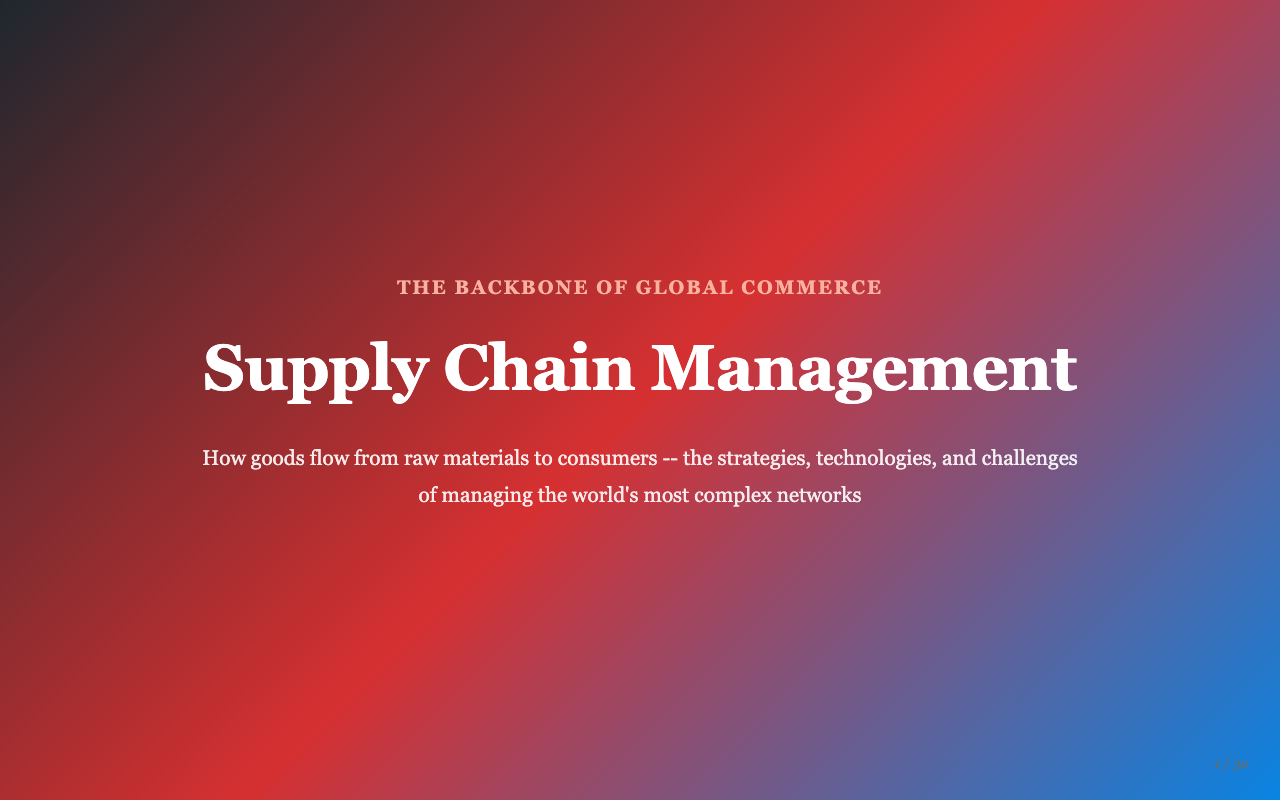
Supply Chain

  • PAGE 01 · OVERVIEW
  • The discipline of moving inputs to outputs to customers — predictably, profitably, and at speed. From Henry Ford's River Rouge to Amazon's anticipatory shipping; from the standardized container to the Suez Canal blockage of 2021.
  • Global trade
  • $32T+3.1%
  • Goods + services 2024 (WTO)
  • Container TEUs
  • 170M+2.4%
  • Global throughput annual
  • Inventory cost
  • 25%+ in 2024
  • Of inventory value · annual carrying
  • Port cluster
  • Top 10 = 60% of global TEUs
  • Illustrative placeholder port image (picsum.photos) · Port of Singapore handles ~38M TEUs/yr
  • What the supply chain is
  • The set of organizations, people, activities, information, and resources involved in moving a product or service from supplier to customer.
  • Five flows simultaneously: PRODUCT INFORMATION CASH RIGHTS RISK
  • "There is no such thing as a free lunch — and there is no such thing as a free supply chain." — Hau Lee, Stanford
Slide 02

Five Stages, End to End

  • PAGE 02 · THE FLOW
  • Plan
  • Demand forecasting, inventory targets, S&OP cadence.
  • Source
  • Supplier selection, contracts, RFQs, multi-sourcing.
  • Make
  • Production scheduling, QA, capacity planning.
  • Deliver
  • Order fulfillment, warehousing, transportation.
  • Return
  • Reverse logistics — defects, recalls, recycling.
  • Enable
  • People, data, processes, governance — the SCOR sixth pillar.
Slide 03

The Box That Changed Everything

  • PAGE 03 · CONTAINER REVOLUTION
  • April 26, 1956. Malcolm McLean, a North Carolina trucker, watches his 58 truck-trailer-sized containers being lifted by crane onto the modified tanker SS Ideal X. Newark to Houston. The shipping cost dropped from $5.86/ton (loose freight) to $0.16/ton. A 36× reduction.
  • Standardized containers (20-foot, 40-foot · TEU/FEU), interchangeable by ship/rail/truck, eliminated the labor of port stevedores reloading goods piece by piece. World trade as a share of GDP doubled by 1990 and tripled by 2010 — Marc Levinson's The Box argues containerization is half the explanation.
  • By the numbers
  • ~25M containers in circulation (2024)
  • ~5,400 container ships globally
  • 24,000+ TEU capacity on largest (HMM Algeciras class)
  • ~$30B in damaged or lost-overboard cargo annually
  • Top 10 ports by TEU · 2024
  • RankPortTEUs (M)
  • 1Shanghai · CN49.2
  • 2Singapore37.3
  • 3Ningbo-Zhoushan · CN36.0
  • 4Shenzhen · CN30.0
  • 5Qingdao · CN28.7
  • 6Guangzhou · CN25.4
  • 7Busan · KR23.2
  • 8Tianjin · CN22.0
  • 9Hong Kong14.4
  • 10Rotterdam · NL14.4
  • —L.A. + Long Beach (US #1)17.3
Slide 04

Inventory: The Buffer

  • PAGE 04 · INVENTORY
  • Inventory absorbs the mismatch between supply and demand timing. Too little = stockouts. Too much = capital tied up, obsolescence, storage cost (~25%/yr of value).
  • Cycle stock
  • Reordered routinely. EOQ formula: Q* = √(2DS/H) where D=demand, S=order cost, H=holding cost.
  • Safety stock
  • Buffer for demand variability. SS = z·σ·√L (z=service-level, σ=demand SD, L=lead time).
  • Pipeline
  • In transit. Average inventory in pipeline = lead-time demand. Long lead = lots of capital afloat.
  • ABC analysis (Pareto)
  • Class% items% revenuePolicy
  • A~20%~80%Tight control · daily counts
  • B~30%~15%Moderate · weekly
  • C~50%~5%Loose · monthly · large reorder
  • Turnover
  • Inventory turns = COGS ÷ avg inventory. Higher = more efficient.
  • IndustryTurns/yr
  • Grocery14–18
  • Fast fashion (Zara)10–14
  • Auto OEMs8–12
  • Apple~38 (best in class)
  • Industrial machinery3–5
  • Luxury watches1–2
Slide 05

Just-in-Time · The Toyota Way

  • PAGE 05 · TOYOTA
  • Postwar Japan, capital-starved. Taiichi Ohno (1912-1990) at Toyota develops the production system later codified by Womack & Jones as Lean Manufacturing.
  • Two pillars
  • Just-in-Time (JIT) — produce only what is needed, when needed, in the quantity needed. Pull, not push.
  • Jidoka (autonomation) — automation with a human touch. Any worker can pull the andon cord to stop the line on a defect.
  • The seven wastes (Muda)
  • Transportation · unnecessary movement of material
  • Inventory · materials waiting
  • Motion · workers moving more than needed
  • Waiting · idle time
  • Over-production · making more than needed
  • Over-processing · features customers don't value
  • Defects · rework, scrap
  • Kanban
  • The signaling card — literally a paper card moved between stations to authorize work. Modern variants: digital Kanban boards, electronic kanban (eKanban), VMI (vendor-managed inventory).
  • Kaizen
  • Continuous, incremental improvement. Workers — not consultants — propose changes. Toyota implements ~1M employee suggestions a year (~80% adopted).
  • "Costs do not exist to be calculated. Costs exist to be reduced." — Taiichi Ohno
  • The fragility tradeoff
  • JIT minimizes inventory cost but maximizes exposure to disruption. March 2011: Tōhoku earthquake/tsunami knocks out Renesas (a key Toyota chip supplier). Production drops by ~800,000 vehicles globally. March 2021: Renesas fire. Same problem, different decade. Toyota subsequently built ~6 months of chip stock — abandoning pure JIT for the most critical components.
Slide 06

The Bullwhip Effect

  • PAGE 06 · BULLWHIP
  • Hau Lee, Stanford 1997. Small variations in end-customer demand amplify upstream into wild swings in supplier orders. The villain: each tier reacts to its own visible demand without seeing the chain.
  • Five drivers
  • Demand-signal processing — overreacting to recent data
  • Order batching — placing big orders periodically rather than continuously
  • Price fluctuations — promotional buys distort demand
  • Rationing/shortage gaming — over-ordering to claim scarce supply
  • Lead-time variability — long lead times widen forecast windows
  • Counter-measures
  • Share point-of-sale data with all tiers (CPFR)
  • Reduce lead times — JIT, near-shoring
  • Smaller, more frequent orders
  • Everyday-low pricing instead of promotional bursts
  • Vendor-managed inventory (Walmart-P&G pilot, 1988)
Slide 07

Modes & Movement

  • PAGE 07 · LOGISTICS
  • ModeCost ($/ton-mi)Speed% of US ton-miBest for
  • Pipeline~0.02Continuous17%Oil, gas, slurry
  • Water (barge)~0.04Slowest5%Bulk commodities (grain, coal)
  • Rail~0.04Slow28%Long-haul bulk, intermodal
  • Truck~0.20Medium42%Door-to-door, time-sensitive
  • Air~0.80Fastest<1% (but ~30% of value)High-value, perishable, urgent
  • Last mile
  • The most expensive segment per kilometer. Up to 50% of total parcel logistics cost. Drone delivery, autonomous vehicles, locker networks, and dark stores all chase the same cost curve.
  • 3PL / 4PL
  • Third-party logistics outsources execution (warehousing, freight). Fourth-party manages the entire network including other 3PLs. DHL, Maersk Logistics, Kuehne+Nagel are top global 3PLs.
  • Incoterms
  • 11 standardized contract terms governing who bears cost/risk where. The most common:
  • TermRisk transfers
  • EXWBuyer at seller's factory
  • FOBOnce on board the vessel
  • CIFSeller pays freight + insurance to port
  • DAPDelivered at place
  • DDPSeller pays everything to door
Slide 08

Case · The Ever Given · 2021

  • PAGE 08 · CASE: SUEZ
  • Mar 23, 2021, 07:40 local. The 400m-long, 220k-ton container ship Ever Given grounds itself diagonally across the Suez Canal during a sandstorm. A 6-day jam ensues. ~370 ships pile up.
  • Suez carries ~12% of global trade and ~30% of container traffic. Lloyd's estimated $9.6B/day in trade was held up. Toilet-paper futures briefly spiked.
  • Refloating: 14 tugboats, 2 dredgers, the spring tide. Freed Mar 29 at 15:05.
  • Lessons retroactively absorbed
  • Single-route concentration is fragile
  • Cape of Good Hope rerouting adds ~10 days, ~$300k fuel per ship
  • "Black swan" was actually a known risk · Suez had been blocked before (1956, 1967, 2004)
  • Companies rebuilt risk registers and resilience plans
  • Illustrative placeholder canal image (picsum.photos) · Suez Canal sees ~50 ships transit per day in normal ops
  • Other choke points
  • Point% world oil
  • Strait of Hormuz~20%
  • Strait of Malacca~25% trade
  • Bab-el-Mandeb (Red Sea)~12% (Houthi attacks 2023-24)
  • Panama Canal~5% (drought 2023-24)
Slide 09

Case · The 2020-22 Squeeze

  • PAGE 09 · CASE: COVID
  • Pandemic shutdowns cratered Q1 2020 demand → orders cancelled → 2H demand surged for goods (not services) → ports overwhelmed → ships waited weeks at LA/LB → factories couldn't ship → semiconductor shortage cascaded into auto, electronics, appliances. The single largest supply-chain stress test of the modern era.
  • The numbers
  • Shanghai-LA freight: $1,500 → $20,000 per FEU (peak Sep 2021)
  • Anchorage queue at LA: 109 ships waiting (Jan 2022)
  • Auto industry lost ~10M units production due to chips
  • Ford profits down ~50% Q1 2022 from chip impact alone
  • Why chips
  • Auto orders cancelled spring 2020. TSMC reallocated capacity to consumer electronics (PCs, phones — booming WFH demand). When auto rebounded, no slots left.
  • Lead times for some chips ran 50+ weeks through 2022.
  • The reset
  • Reshoring, friend-shoring, China+1. CHIPS Act 2022 ($52B U.S. fab subsidy). India and Vietnam gain export share.
  • By Q4 2023, freight rates back at $1,500/FEU. The cycle turned.
Slide 10

Resilience: Beyond Efficiency

  • PAGE 10 · RESILIENCE
  • The classic tradeoff
  • Optimizing for cost (fewer suppliers, lower inventory, longer routes) maximizes efficiency. Optimizing for resilience (multiple sources, buffers, shorter routes) maximizes survivability. The 2020s have rewritten the optimum.
  • Levers
  • Multi-sourcing — at least two qualified suppliers per critical part
  • Geographic diversification — no >30% single-country exposure
  • Strategic stockpiling — months of safety stock on bottleneck inputs
  • Visibility — tier-2 and tier-3 mapping (Apple maps tier-4 for cobalt)
  • Substitutability — design products with alternative materials
  • Financial hedging — supplier financing, credit insurance
  • Risk heatmap
  • SKU × supplier risk · 12 weeks forward
  • Stress tests
  • Simulate: a typhoon hits Taiwan; the Strait of Hormuz closes; a tier-2 supplier files Chapter 11. What's the customer impact in 30/60/90 days?
Slide 11

The Metrics That Matter

  • PAGE 11 · METRICS
  • OTIF
  • On-Time, In-Full. Industry benchmarks 90–95%. Walmart targets 98% from suppliers; charges fines below.
  • Fill Rate
  • % of customer demand met from stock. SKU-level metric. 95%+ for retail FMCG.
  • DOI
  • Days of Inventory. Stock ÷ daily COGS. Apple ~9 days. Costco ~30 days. Boeing parts ~250 days.
  • Cash Conversion Cycle
  • DIO + DSO − DPO. How long cash is tied up. Negative CCC (Amazon: ~−30 days) means suppliers fund growth.
  • Perfect Order
  • On-time, complete, undamaged, accurately invoiced. ~80% of orders qualify in best-in-class retail.
  • Forecast Accuracy
  • 1 − MAPE. SKU-level forecasts >70% are great; aggregate forecasts often >90%.
  • Supplier OTD
  • On-time delivery from suppliers. Below 95% triggers QBR escalation in most procurement orgs.
  • Carbon (Scope 3)
  • Most companies' biggest emissions are upstream. Walmart's Project Gigaton: 1B tons CO₂e cut by 2030.
Slide 12

The Common Mistakes

  • PAGE 12 · MISTAKES
  • Optimizing one stage in isolation. Local optima do not aggregate to global optimum.
  • Buying volume discounts that exceed inventory carrying cost.
  • Sole-sourcing critical inputs to save 3% — losing 30% of revenue when the supplier fails.
  • Ignoring tier-2 and tier-3 visibility. Your "diverse" supplier base may all depend on one Taiwanese fab.
  • Confusing low cost with low total cost of ownership (TCO).
  • Building a forecast based on shipments instead of consumer demand. Bullwhip in waiting.
  • Treating safety stock as fixed; it should scale with √(lead time).
  • Promising 99.9% service level on 100% of SKUs — cost is exponential past 95%.
  • Using transportation modes by habit. Air can be cheaper than ocean once inventory cost is included.
  • Treating sustainability as a side project. Customers, regulators, and capital all now price it in.
Slide 13

Reading & Watching

  • PAGE 13 · READING
  • Books
  • Levinson — The Box
  • Womack, Jones & Roos — The Machine That Changed the World
  • Ohno — Toyota Production System
  • Goldratt — The Goal (theory of constraints, novel form)
  • Liker — The Toyota Way
  • Sheffi — The Resilient Enterprise
  • Christopher — Logistics & Supply Chain Management
  • Simchi-Levi — Designing & Managing the Supply Chain
  • YouTube
  • CNBC — supply-chain documentaries
  • Bloomberg — port + freight market coverage
  • Wendover Productions — logistics deep dives (containers, FedEx, etc.)
  • What's Going On With Shipping — Sal Mercogliano · the daily shipping briefing
  • Stanford GSB — Hau Lee, supply chain management
  • Data sources
  • WTO Statistics · BTS.gov · UNCTAD · Drewry Shipping · Freightos · Bloomberg Container Index
Slide 14

Logout · End of Shift

  • PAGE 14 · END
  • "In supply chain, you are only as strong as your weakest tier." — attributed across the discipline
  • Fourteen pages of dashboards. The control tower closes for the day. The boxes keep moving — 24/7, 365 — across 5,400 ships, 2.5 million trucks, half a million planes, and the tens of millions of warehouse bays in between. Every flat-pack shelf you've ever bought is the legible tip of an invisible system.
  • $ logout
  • ← The Deck Catalog · Business & Economics index · Vol. VII · Deck 08 · Supply Chain
Remove this deck