shipslides
Technology15 slides0 views

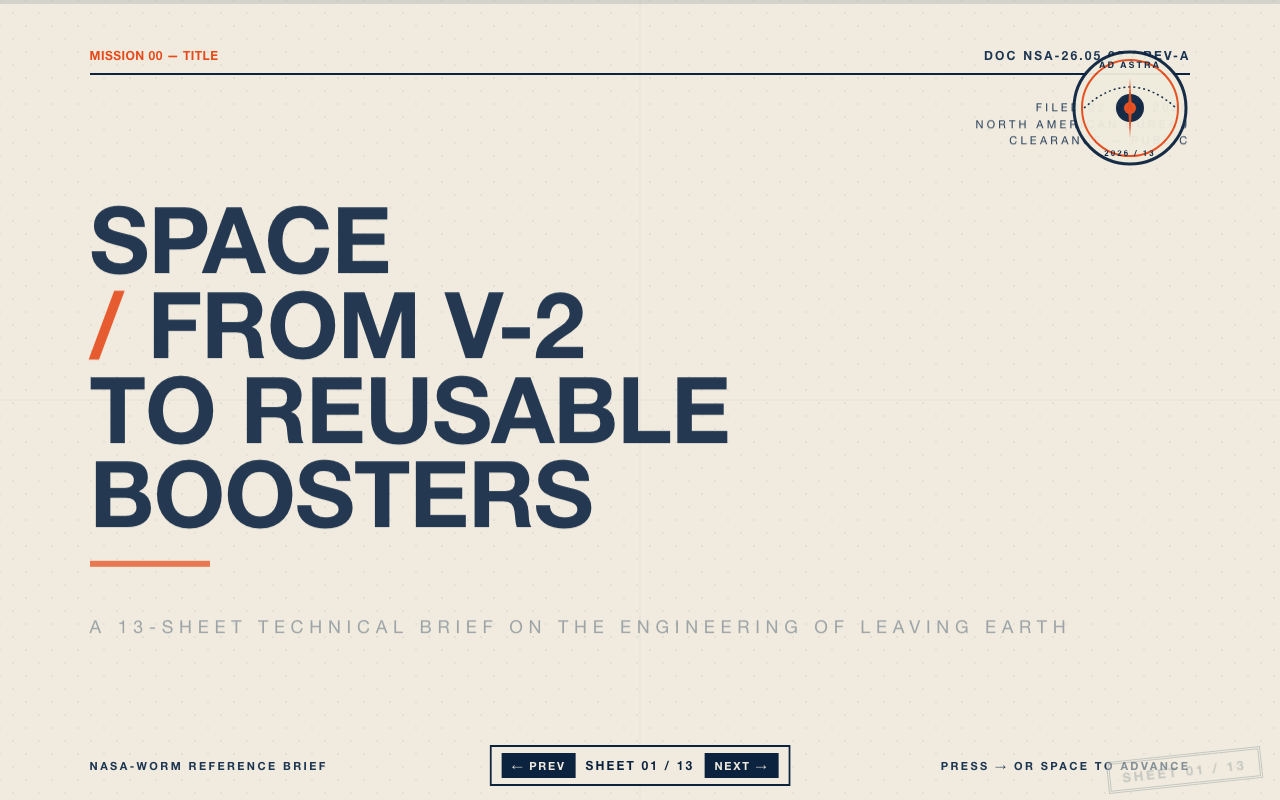
Space Technology

Seven decades of getting hardware out of the gravity well — and increasingly bringing it back.

StandaloneDownload
Sandboxed deck
Open raw

About this HTML presentation

This Shipslides page presents Space Technology as an interactive HTML presentation deck in the Technology catalog with 15 slides. The share page keeps the uploaded deck sandboxed while exposing readable context, topics, and a slide outline for viewers and search engines.

Seven decades of getting hardware out of the gravity well — and increasingly bringing it back. Key sections include: Above.; Sputnik 1.; 1957–1969.; Apollo 11.; Space Shuttle.; The ISS.; Reusability changes the curve.; Stainless. Reusable. Big.; The rocket equation.; Who launches..

Key sections

  • 01Above.
  • 02Sputnik 1.
  • 031957–1969.
  • 04Apollo 11.
  • 05Space Shuttle.
  • 06The ISS.
  • 07Reusability changes the curve.
  • 08Stainless. Reusable. Big.
  • 09The rocket equation.
  • 10Who launches.
  • 11The film.
  • 12Where we put things.
  • 13Constellations.
  • 14Key terms.
  • 15Open problems.

Topics covered

Slide outline
  1. 01Above.
  2. 02Sputnik 1.
  3. 031957–1969.
  4. 04Apollo 11.
  5. 05Space Shuttle.
  6. 06The ISS.
  7. 07Reusability changes the curve.
  8. 08Stainless. Reusable. Big.
  9. 09The rocket equation.
  10. 10Who launches.
  11. 11The film.
  12. 12Where we put things.
  13. 13Constellations.
  14. 14Key terms.
  15. 15Open problems.
Page data
Canonical
https://shipslides.com/d/technology-space-tech
Category
Technology
Size
440.4 KB
Updated
2026-05-17
LLM text
https://shipslides.com/d/technology-space-tech/llms.txt

Presentation Transcript

Detailed slide-by-slide text content extracted from this presentation.

Slide 01

Above.

  • 01 / 15
  • Deck 07 · Space Technology
  • Seven decades of getting hardware out of the gravity well — and increasingly bringing it back.
Slide 02

Sputnik 1.

  • 02 / 15
  • October 4, 1957
  • An aluminum sphere, 58 cm across, 83.6 kg, four whip antennas, two radio transmitters. Launched from Tyuratam (now Baikonur) on an R-7 ICBM derivative. It beeped at 20 and 40 MHz for three weeks, audible on shortwave radios worldwide. It changed everything.
Slide 03

1957–1969.

  • 03 / 15
  • Space Race
  • '57
  • Sputnik 1
  • First artificial satellite.
  • '61
  • Vostok 1
  • Yuri Gagarin, first human in space.
  • '62
  • Friendship 7
  • John Glenn orbits.
  • '65
  • Voskhod 2
  • Leonov, first EVA.
  • '66
  • Luna 9
  • First soft Moon landing.
  • '69
  • Apollo 11
  • Armstrong, Aldrin land.
Slide 04

Apollo 11.

  • 04 / 15
  • July 20, 1969
  • Saturn V, 110.6 m tall, 2,970 t fully fueled — still the most powerful rocket to fly successfully until 2024. Eleven minutes from launch to LEO; 76 hours to lunar orbit; six and a half hours from landing to first step.
  • Saturn V, by stage:
  • S-IC → 5 × F-1, kerosene/LOX, 33,400 kN takeoff thrust
  • S-II → 5 × J-2, hydrogen/LOX
  • S-IVB → 1 × J-2, restart-capable, trans-lunar injection
Slide 05

Space Shuttle.

  • 05 / 15
  • 1981–2011
  • The Space Transportation System flew 135 missions over 30 years. It carried Hubble (1990), Magellan, Galileo, and assembled most of the International Space Station. Two orbiters were lost — Challenger (1986, O-ring failure) and Columbia (2003, foam strike).
  • OrbiterFirst flightMissions
  • Columbia (OV-102)198128
  • Challenger (OV-099)198310
  • Discovery (OV-103)198439
  • Atlantis (OV-104)198533
  • Endeavour (OV-105)199225
Slide 06

The ISS.

  • 06 / 15
  • since 1998
  • 419 t. 109 m × 73 m. Over 250 visitors from 19 countries. Continuously crewed since November 2, 2000. Orbit: ~408 km, 51.6° inclination, 92 min/orbit. The first major U.S.–Russian engineering partnership of the post-Cold-War era; planned deorbit ~2031.
Slide 07

Reusability changes the curve.

  • 07 / 15
  • Falcon 9 · 2010
  • SpaceX's first Falcon 9 booster recovery was December 21, 2015 (Orbcomm-2). By 2024, individual boosters had flown 20+ times. Per-launch cost to LEO fell from ~$10,000/kg in the Shuttle era to roughly $1,500/kg on Falcon 9 — a step change unmatched since the 1960s.
Slide 08

Stainless. Reusable. Big.

  • 08 / 15
  • Starship
  • 121 m fully stacked. 33 Raptor engines on Super Heavy. Methane/LOX. First integrated test flight April 20, 2023. By IFT-5 (October 2024) the Super Heavy booster returned to the launch tower and was caught by the Mechazilla arms — a first in spaceflight.
Slide 09

The rocket equation.

  • 09 / 15
  • Math
  • Tsiolkovsky's 1903 equation determines the velocity change a rocket can achieve:
  • Δv = v_e · ln(m_0 / m_f)
  • = I_sp · g_0 · ln(m_0 / m_f)
  • For LEO from Earth's surface, ~9.4 km/s of Δv is needed (including gravity and drag losses). Liquid hydrogen/LOX yields I_sp ≈ 450 s; methane/LOX ≈ 350 s; kerosene/LOX ≈ 310 s. Staging is the only way to reach orbit on chemical fuels.
Slide 10

Who launches.

  • 10 / 15
  • Players, 2026
  • NASA
  • SLS, Orion, Artemis program — return to the Moon (Artemis II 2026).
  • SpaceX
  • Falcon 9, Falcon Heavy, Dragon, Starship; Starlink (~6,000 sats).
  • ESA
  • Ariane 6, Vega-C; lunar & Mars science.
  • Roscosmos
  • Soyuz, Proton successors; Luna program.
  • CNSA
  • Tiangong station, Long March family, Chang'e lunar missions.
  • ISRO
  • Chandrayaan-3 lunar landing 2023, Gaganyaan crewed program.
  • Rocket Lab
  • Electron, Neutron in development.
  • Blue Origin
  • New Shepard, New Glenn, Blue Moon lander.
Slide 11

The film.

  • 11 / 15
  • Watch this
  • Watch: starship test flight
Slide 12

Where we put things.

  • 12 / 15
  • Orbits
  • RegimeAltitudeUse
  • LEO~200–2,000 kmISS, Starlink, Earth observation
  • MEO~2,000–35,786 kmGPS (~20,200 km), Galileo, GLONASS
  • GEO35,786 kmCommunications, weather (geostationary)
  • SSO~600–800 km, polarEarth imaging, sun-synchronous orbit
  • HEO & lunarup to ~400,000 kmJames Webb (L2), Artemis, Gateway
Slide 13

Constellations.

  • 13 / 15
  • Side note
  • SpaceX's Starlink crossed 6,000 active satellites in 2024 — more than any government program. Amazon's Kuiper began launching in 2023. China's Guowang is in early deployment. The total catalogued objects in LEO doubled between 2018 and 2024.
  • Light pollutionConjunction riskSpectrumReentry debris
Slide 14

Key terms.

  • 14 / 15
  • Glossary
  • TermMeaning
  • Δv (delta-v)Velocity change a maneuver costs.
  • Specific impulseThrust per unit propellant mass flow; engine efficiency.
  • Hohmann transferTwo-burn elliptical orbit between coplanar circular orbits.
  • Lagrange pointEquilibrium of two-body gravity + orbital motion (L1–L5).
  • AerobrakingUsing atmospheric drag to lower an orbit.
Slide 15

Open problems.

  • 15 / 15
  • Fully reusable orbital launch with rapid turnaround.
  • In-space propellant transfer at scale (Starship HLS depends on it).
  • Long-duration human spaceflight: radiation, bone loss, closed-loop life support.
  • Active debris removal in low Earth orbit.
  • A repeatable economic case for cislunar industry beyond government anchor tenancy.
  • ← Master catalog
  • Technology index
  • Top ↑
Remove this deck